OBD2 Scanner Error Codes Explained
If you’ve ever seen that dreaded check engine light pop up on your dashboard, you know how frustrating it feels. That little light doesn’t tell you much, does it? It just glows there, mocking you, while you wonder if your car is about to fall apart or if it’s something simple. This is where an OBD2 scanner comes in handy. These devices read the trouble codes your car produces and help you figure out what’s actually wrong. Let’s break down how these codes work and what they mean so you can tackle car problems like a pro.
In this article
What Is An OBD2 Scanner Anyway?
Before we dive into error codes, let’s talk about what an OBD2 scanner actually is. OBD stands for On-Board Diagnostics. Think of it as your car’s built-in doctor. Every modern vehicle has a computer system that monitors how your engine, transmission, and other systems run. When something goes wrong, your car’s computer catches it and stores a code.
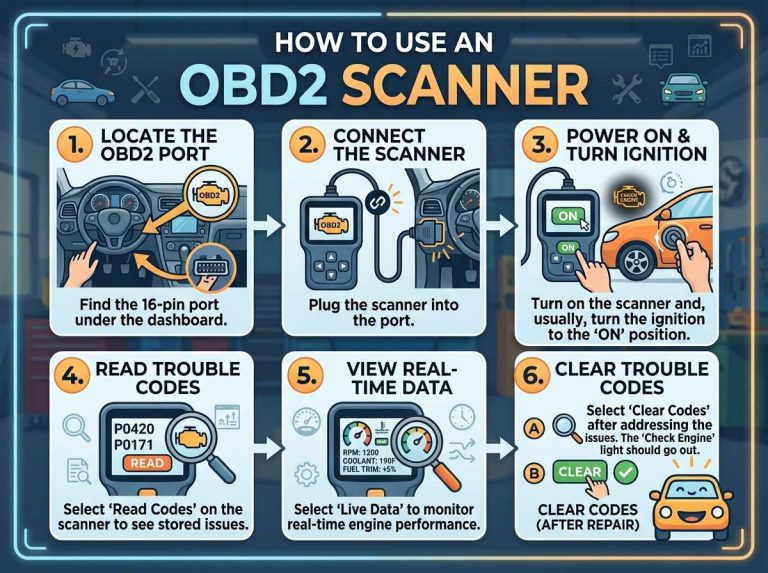
An OBD2 scanner is a handheld device that plugs into a port under your steering wheel. It connects to your car’s computer and pulls out those stored codes. Instead of guessing what’s wrong with your car, you get real information. The scanner reads diagnostic trouble codes, which are basically your car’s way of telling you exactly what needs attention.
These devices range from super cheap to professional-grade expensive. For most car owners, a basic scanner works just fine. It gives you the code number and a simple description of what went wrong.
How Do Error Codes Work?
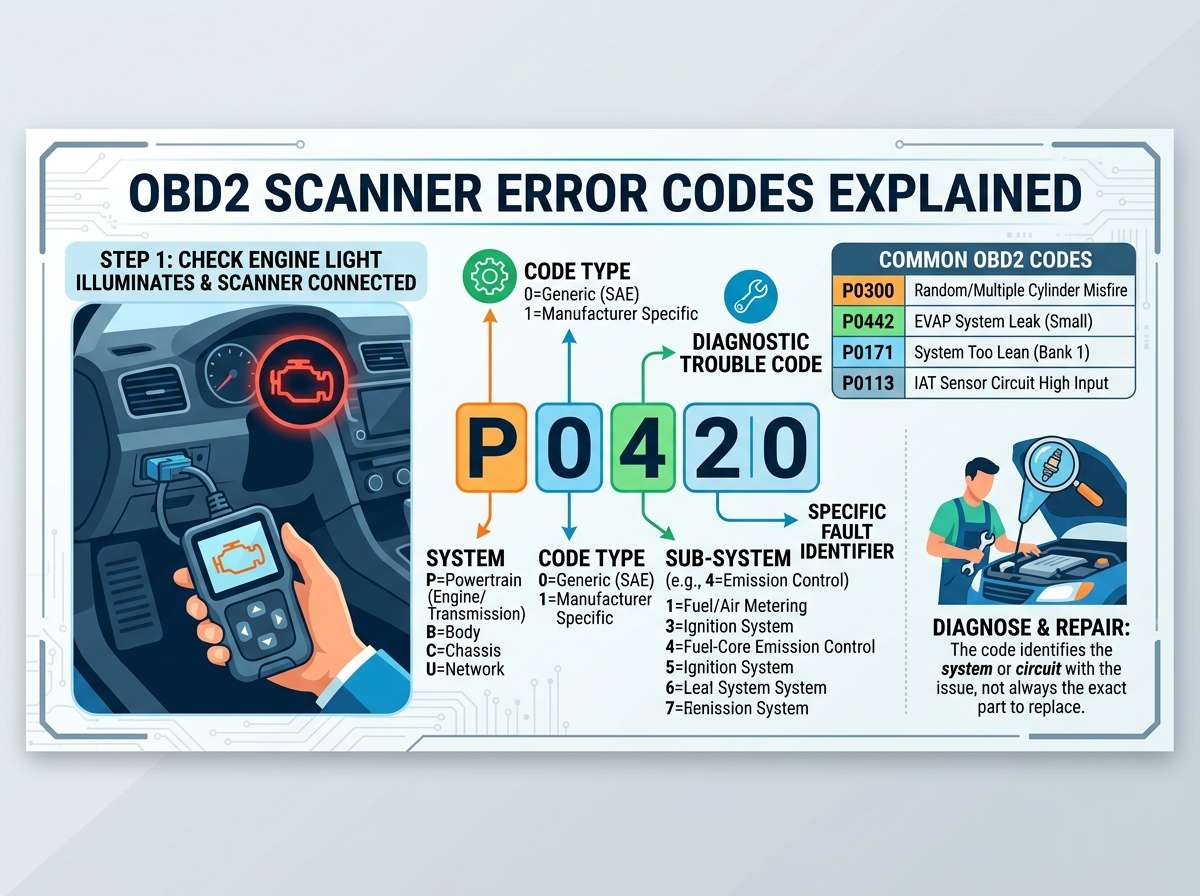
Car error codes follow a specific pattern that makes them easier to understand once you learn the system. Every code starts with a letter followed by four numbers, like P0301 or C0045.
The first letter tells you what system is having problems. The letter P means powertrain issues (your engine and transmission). The letter C refers to chassis problems (your brakes and suspension). The letter B indicates body system troubles (your windows and seats). The letter U points to network communication issues (when different computer systems can’t talk to each other).
The first number after the letter matters too. If it’s a zero, the code is a standard code that applies to all cars. If it’s a one, the code is specific to that particular car brand.
The next two numbers narrow things down further. They tell you which specific system is causing the trouble. For example, codes starting with P0100 involve your air intake. Codes starting with P0200 deal with your fuel injectors.
The last number gets even more specific. It tells you exactly what the problem is. So P0101 means your mass air flow sensor is not reading correctly. This system might sound complicated, but once you see a few codes, the pattern becomes clear.
Breaking Down The Most Common Error Codes
Let’s look at the codes you’ll actually run into. These are the troublemakers that show up on thousands of cars every single day.
P0300: Random Misfire Detected
This code means your engine is misfiring. Basically, one or more of your cylinders aren’t firing correctly. Your engine runs on controlled explosions of fuel. When a cylinder doesn’t fire properly, your car runs rough and jerks around.
Common reasons for this include bad spark plugs, a faulty ignition coil, bad fuel, or fuel injector problems. Sometimes dirty fuel filters cause this too. The fix ranges from simple (new spark plugs cost about forty bucks) to more expensive (fuel injectors run a couple hundred dollars).
P0171: System Too Lean
Your car’s engine needs the right balance of fuel and air. Too much air and not enough fuel creates a lean condition. When this happens, your car runs hot and doesn’t perform well.
This code often points to a failing oxygen sensor. Your oxygen sensors tell your engine’s computer how much fuel to pump. Bad sensors send wrong signals. You might also have a vacuum leak, a broken fuel injector, or a bad fuel pump. This fix typically costs between one hundred and four hundred dollars depending on which part fails.
P0507: Idle Air Control System High
Your car idles at a set speed when you stop. If that idle speed climbs higher than it should, you get this code. Your engine might rev up to two thousand RPM when it should sit at five hundred RPM.
Usually this comes from a vacuum leak, a dirty air intake valve, or a faulty idle control valve. Sometimes a bad oxygen sensor causes this too. The good news is these fixes usually don’t cost too much. Most repairs run between one hundred and three hundred dollars.
P0128: Coolant Thermostat Malfunctioning
Your car’s thermostat controls how hot your engine gets. When it fails, your car either runs too hot or stays too cold. This code means your engine is running too cool.
A broken thermostat is the obvious culprit. Sometimes a bad coolant temperature sensor causes false readings. Replacing a thermostat runs about one hundred to two hundred dollars. Replacing a temperature sensor costs about the same.
P0455: Evaporative Emission Control System Leak (Large)
Your fuel tank releases vapors. Your car has a system that captures these vapors so they don’t hurt the environment. When that system leaks badly, you get this code.
Common causes include a loose or missing gas cap (seriously, check that first), a cracked charcoal canister, or broken hoses. Sometimes the purge control valve fails. A gas cap costs five dollars. A charcoal canister runs two hundred to five hundred dollars. Check the cheap stuff first before spending big money.
P0606: PCM/ECM Processor Fault
Your car’s computer isn’t working right when you get this code. Your PCM (Powertrain Control Module) or ECM (Engine Control Module) is having problems processing information.
This could mean a loose battery connection, corroded battery terminals, or actual computer damage. Start by checking your battery connections. If they’re clean and tight, you might need professional computer diagnostics. This fix can run expensive, from three hundred to a thousand dollars or more.
P0725: Engine Speed Input Circuit Malfunction
Your car’s computer needs to know how fast your engine is turning. A sensor sends this information. When that sensor or its wiring fails, you get this code.
Bad engine speed sensors are common culprits. Damaged wiring or loose connections cause it too. Replacing a sensor costs between one hundred and three hundred dollars depending on which one and where it sits.
P1000: OBD System Readiness Self-Test Not Complete
This code just means your car’s diagnostic system isn’t ready to run tests yet. It usually shows up after you clear other codes or disconnect your battery. Drive your car normally for a while, and this code should disappear on its own.
Understanding Severity Levels
Not all codes are equally serious. Some codes mean pull over and call a tow truck. Others mean keep driving but visit a mechanic soon.
Codes with a zero in the second position are the most serious. These are emissions system issues and engine problems that affect how your car runs. You should address these quickly.
Codes with a one in the second position are manufacturer-specific codes. They vary by car brand but usually indicate engine or transmission issues. These need attention but aren’t always urgent emergencies.
Why Do Error Codes Come Back?
You clear a code, the light turns off, and then three days later it comes back. Frustrating, right? This usually means you fixed a symptom but not the root cause.
Let’s say you get a P0171 code for a lean running condition. You replace the oxygen sensor and clear the code. But what if your real problem is a vacuum leak? The new sensor will read that lean condition again, and boom, the code returns.
This is why diagnosing car problems properly matters. You need to find the actual cause, not just the code. Sometimes you need a mechanic’s computer to run live data tests. You need to watch real sensor readings to figure out what’s actually broken.
Getting Started With Your Own Scanner
If you want to check your own codes, start with a basic OBD2 scanner. They cost twenty to fifty dollars and do exactly what you need for simple diagnostics. Plug it into that port under your steering wheel, turn your key to the on position without starting the engine, and let the scanner connect.
Once connected, select read codes. The scanner pulls up any stored codes and pending codes. Stored codes are problems the computer found and logged. Pending codes are codes that haven’t triggered the check engine light yet.
Write down your codes and research them online. Look at the real symptoms your car is showing. Does it run rough? Won’t start? Runs hot? These symptoms combine with the codes to point toward the problem.
DIY Fixes You Can Actually Do
Some codes point to problems you can fix yourself without special tools.
Loose gas caps are the easiest. Your fuel cap seals the tank. A loose one triggers P0455 codes. Tighten or replace it and you might be done.
Corroded battery terminals cause multiple codes. Pop your hood, look at your battery terminals. If they’re crusty and green or white, grab a wire brush and clean them. This simple fix takes five minutes and costs nothing.
Spark plugs are doable if you’re handy. Most cars let you access them from the top of the engine. Pull off the coil pack or spark plug wires, unscrew the old spark plug, and screw in a new one. Watch a YouTube video for your specific car first.
Bad O2 sensors are doable if you’re comfortable with basic tools. They usually screw out from the exhaust manifold or exhaust pipe. A socket and extension get them out. New ones cost twenty to fifty dollars.
When To See A Professional Mechanic
Some repairs really need a shop. Transmission problems, computer issues, and complicated vacuum leaks need professional equipment and expertise.
If your code involves the transmission, see a mechanic. Transmission work requires special knowledge. Same goes for codes pointing to engine overheating or running too lean. These problems need proper diagnosis.
Computer codes like P0606 should go to a professional. They have the tools to tell if it’s a connection problem or actual computer failure.
Reading Live Data For Better Diagnosis
Advanced scanners can show live data. This means you see sensor readings in real time while your car runs. This helps mechanics pinpoint problems accurately.
For example, if you have a lean code, a mechanic can watch the oxygen sensor reading, the fuel injector pulse width, and the engine load while driving. These readings tell the story of what’s really happening.
Most beginners don’t need live data tools, but if your mechanic mentions it, that’s what they’re doing. They’re watching your car’s data while it runs to see what’s wrong.
Preventing Error Codes
The best error code is one that never shows up. Regular maintenance stops most problems before they start.
Change your oil on schedule. Clean oil keeps your engine running right. Replace spark plugs when your manual says to. Replace air filters when they get dirty. Top off your coolant and keep your battery terminals clean.
Drive carefully too. Aggressive driving and ignoring small problems lead to big codes later. That slight vibration becomes a bent rim. That small leak becomes a major repair.
The Final Word
Error codes might seem mysterious, but they’re actually your car’s way of helping you. Instead of guessing what’s wrong, your car tells you. An OBD2 scanner simply translates that message.
Start by getting a basic scanner. Pull your codes. Research what they mean. Combine that information with how your car actually behaves. Most of the time, this points straight to the problem.
Some fixes you can do yourself. Others need a mechanic. Either way, you’re now informed instead of confused. You can talk to your mechanic knowing what codes you have. You can ask smart questions instead of just nodding along.
The check engine light isn’t your enemy. It’s actually helping you catch problems early. Respect that light, act on it, and your car will reward you with years of reliable service. Now get out there and diagnose those codes like a pro.

Peterson is an automotive safety enthusiast and product reviewer with a passion for helping drivers stay safe on the road. He researches and tests dash cams, backup cameras, TPMS systems, emergency tools, GPS trackers, and other vehicle safety products to provide honest, practical recommendations. Through CarSafeties.com, Peterson shares in-depth reviews, buying guides, and maintenance tips to help drivers make smarter and safer decisions.