How to Use Jumper Cables Safely?
Dead car battery got you stuck in your driveway? A set of jumper cables can get you back on the road fast. But here’s the thing: if you don’t use them right, you could fry your car’s electrical system or even hurt yourself. The good news is that jump-starting a car is easier than you think once you know what you’re doing.
In this article
This guide walks you through everything you need to know about using jumper cables safely. Whether you’re a first-timer or just want a refresher, you’ll learn the right way to bring your dead battery back to life.
Why Jumper Cables Matter
Your car battery stores electrical energy that starts your engine. When that battery dies, nothing happens when you turn the key. You get silence, clicking sounds, or just darkness on the dashboard. That’s where jumper cables come in.
Jumper cables let you borrow power from another car’s working battery to start your own car. It’s a lifesaver when you’re stranded, but it only works if you do it right. Bad technique can damage both cars, ruin expensive electronics, or cause burns.
What You Need Before You Start
Before you hook anything up, grab these items:
Jumper cables. You can’t jump-start without them. Get a pair that’s at least 4 to 6 gauge thickness. Thicker cables carry power better than thin ones. Look for cables that are 12 to 16 feet long so you have enough reach between vehicles.
A second vehicle with a working battery. The donor car needs a functioning battery with enough power to share. The battery should be about the same voltage as yours (usually 12 volts in most cars).
A safe, flat location. Never try this on a slope or in traffic. Find level ground where both cars can park safely and stay put for a few minutes.
Safety gear. Grab a pair of work gloves and maybe some safety glasses. Batteries contain corrosive acid, so protect your skin and eyes.
Check your car’s manual before you start. Some newer cars with fancy electronics have special rules about jump-starting. A few vehicles shouldn’t be jump-started at all, and you’ll want to know that before you try.
Getting Your Cars Ready
Now that you have everything together, it’s time to prep the vehicles. This step matters because it prevents accidents and fires.
Turn off both engines. Make sure both cars are completely off before you touch the battery or cables. Touching metal to a live battery can spark or shock you.
Open the hoods. Pop both hoods and let them stay open. You need clear access to both batteries so you can reach the terminals.
Identify the terminals. Every battery has two metal posts sticking out of the top. One post is marked with a plus sign (+) for positive. The other has a minus sign (−) for negative. On most cars, the positive terminal is red and the negative is black, but always double-check by looking for the actual signs.
Clean the terminals if needed. If you see white, blue, or green crusty stuff on the terminals, that’s corrosion. Wipe it away with a clean cloth or paper towel. Corrosion blocks the power flow and makes a bad connection.
Keep metal away from the battery. Don’t set your tools or jewelry on top of the battery. A metal object that touches both terminals can cause a spark or short circuit. Keep watch while the cables are connected.
Connecting the Jumper Cables Step by Step
This is the most important part. Follow the order exactly. If you mess up the sequence, you risk sparks, electrical fires, or damage to your car’s computer.
The Right Order Matters
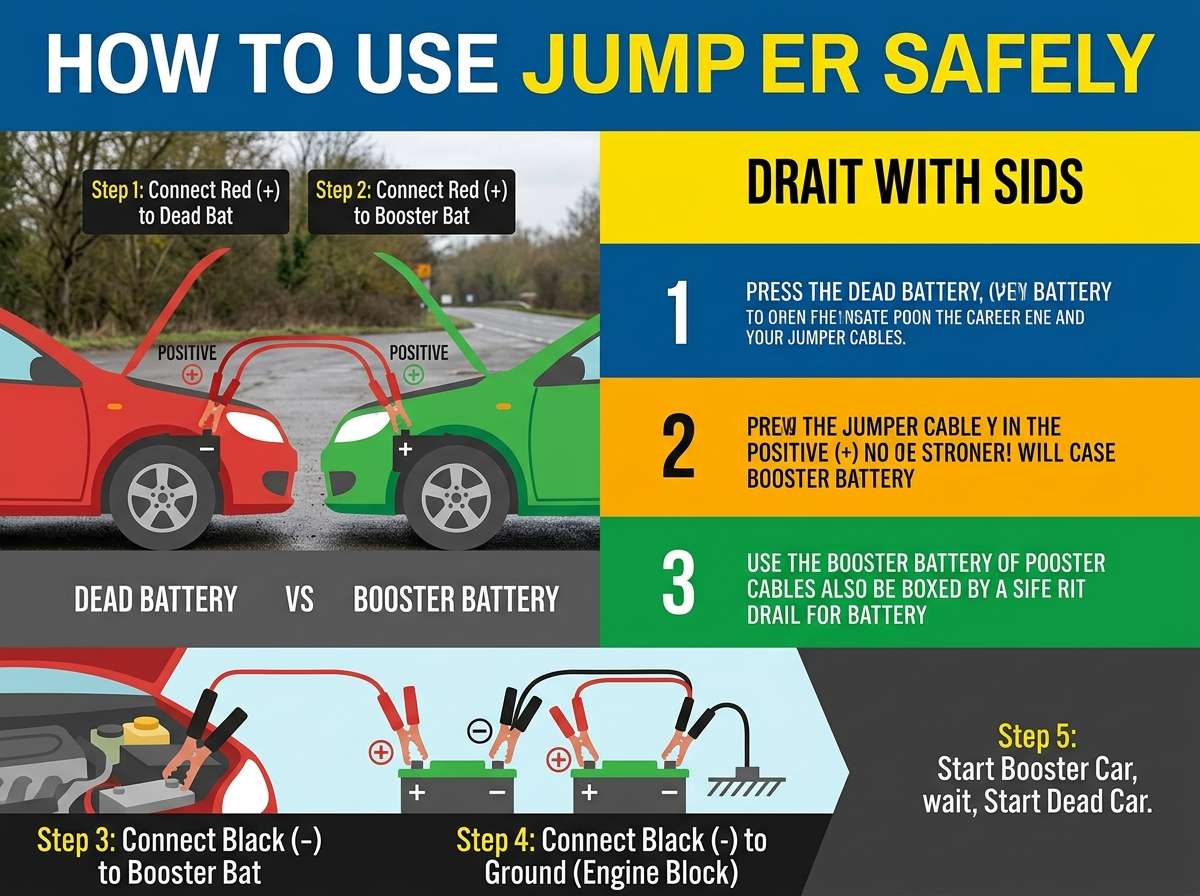
Step One: Attach the red cable to the dead battery’s positive terminal. Grab the red clamp and clip it firmly onto the positive post of your car’s dead battery. You should hear a click or feel it lock down tight. A loose connection won’t transfer power well.
Step Two: Attach the other red clamp to the working battery’s positive terminal. Now take the other end of that red cable and clamp it onto the positive terminal of the donor car’s battery. This creates the positive circuit between both cars.
Step Three: Attach the black cable to the working battery’s negative terminal. Grab the black cable and clamp it onto the negative terminal of the working car’s battery. This is crucial: you’re not connecting to your dead battery’s negative terminal yet.
Step Four: Attach the black cable to an unpainted metal surface on your car. Here’s where most people mess up. Instead of clamping the last black cable to your dead battery’s negative terminal, clamp it to a bare metal bolt, nut, or unpainted surface on your engine block or car frame. This safety step protects your battery from sparks. Sparks near a dead battery can ignite gases that come from the battery, causing an explosion.
Let me be clear on this: the last cable does NOT go on your dead battery’s negative terminal. It goes on bare metal somewhere else on your car’s engine or frame.
Starting the Donor Car
Once all four clamps are locked down tight, start the engine of the car with the good battery. Let it run for a few minutes. This gives the working battery time to charge your dead battery a bit. The longer you wait, the better the charge transfer.
During this waiting time, sit in the donor car and listen. You shouldn’t hear any buzzing, clicking, or popping sounds. If you do, turn off the engine right away and check your connections. Something isn’t right.
Starting Your Car
After a few minutes of the donor car running, try to start your car. Turn the key in the ignition like normal. The engine should turn over and start. If it doesn’t start right away, don’t keep cranking. That drains both batteries fast. Wait another minute and try again.
Once your engine starts, let it run for at least a minute. Your alternator (the part that recharges your battery while the engine runs) needs time to pump power back into your battery.
Disconnecting the Cables
This step is just as important as connecting them. Disconnect in the exact opposite order of how you connected them. This prevents sparks and keeps your car’s electronics safe.
Step One: Remove the black cable from your car. Unclamp the black cable from the unpainted metal surface on your engine or frame. This removes the safety ground.
Step Two: Remove the black cable from the donor car. Now unclamp the black cable from the negative terminal of the working battery. This breaks the negative circuit.
Step Three: Remove the red cable from the working battery. Unclamp the red cable from the positive terminal of the donor car’s battery.
Step Four: Remove the red cable from your car. Finally, unclamp the red cable from your car’s positive terminal. Now you’re fully disconnected.
Do this slowly and carefully. You’re removing power sources, so take your time and make sure each clamp releases cleanly.
What Not to Do
Car jumping has some serious do-nots. Break these rules and you’ll regret it.
Don’t jump-start with wet hands. Water is a conductor, and electricity plus wet hands equals danger. Dry your hands completely before touching the cables or terminals.
Don’t smoke or use open flames. Batteries release hydrogen gas, which is extremely flammable. A spark near that gas can cause an explosion. No cigarettes, no lighters, nothing.
Don’t jump a battery that looks cracked or leaking. If your battery is obviously damaged, don’t try to jump it. The acid inside can leak out and burn your skin. Call for a tow instead.
Don’t leave your car running without the hood down. Once you’ve started your car and disconnected the cables, close the hood. Your alternator will work better with normal airflow, and you won’t have any accidental contact with hot engine parts.
Don’t touch the cables while either engine is running. Metal conducts electricity, and a running engine means active electrical flow. Even after you’ve started your car, keep your hands off the cables and clamps until both engines are off.
Don’t attempt to jump-start a car with an automatic transmission if you’re not sure how. Most automatics can be jump-started the same way, but some newer models have rules. Check your manual.
Don’t reverse the polarity. If you somehow swap positive and negative, you could fry your entire electrical system in seconds. This is why the order of connection matters so much. Take your time and double-check.
Common Mistakes People Make
Even with good intentions, people mess up. Here are the most common mistakes that cause problems.
Connecting the black cable to the wrong place. The biggest mistake is putting the final black cable on your dead battery’s negative terminal instead of on unpainted metal elsewhere on the engine. This causes sparks that can ignite battery gases. Always connect to bare metal on the engine block or frame instead.
Using damaged or thin cables. Old, frayed, or thin cables don’t carry power efficiently. If your cables are more than ten years old or show wear, replace them. Cheap cables from gas stations might work in a pinch, but invest in good ones.
Not letting the donor car run long enough. Impatient drivers try to start too soon. Give the donor car at least three to five minutes of running time. This charges your battery enough to actually start your engine.
Trying to jump-start when the battery is too cold. In freezing weather, cold batteries don’t work well. If your car won’t start in extreme cold, try again once it warms up. You might need a battery heater or blanket.
Forgetting to disconnect before driving. Some people drive around with the cables still attached. This is dangerous and can damage the cables or the cars. Always disconnect completely before you drive away.
How to Keep Your Battery Healthy
The best jump-start is one you never need. Keep your battery in top shape with these simple habits.
Turn off lights before you leave the car. Interior lights and headlights left on overnight will drain your battery. Make it a habit to check before you close the door.
Limit short trips. Quick drives around town don’t give your alternator time to fully recharge the battery. Take longer drives now and then to top off the charge.
Clean your battery terminals regularly. Corrosion builds up over time. Wipe down the terminals with a cloth every month or two. This keeps the connection clean and power flowing.
Park in the shade on hot days. Extreme heat damages batteries faster. If you can, park where your car stays cool.
Don’t leave your car sitting for weeks. A parked car’s battery drains slowly even when the engine is off. If you won’t drive for a long time, disconnect the negative terminal or use a battery maintainer.
Get your battery tested. Most auto parts stores test your battery for free. They’ll tell you how much charge it holds and whether you need a new one soon.
When to Call a Professional
Sometimes you shouldn’t jump-start. Knowing when to get help is just as important as knowing how to do it yourself.
If your car won’t start even after a jump. A successful jump means your car starts and keeps running. If the engine turns over but won’t catch, something else is broken. Don’t keep trying. Get roadside assistance.
If you see smoke or smell burning. These are signs of fire risk. Stop immediately, call for help, and move away from the car.
If your battery is visibly damaged. Cracks, leaks, or bulges mean the battery is bad. Don’t try to jump a dead battery that’s also damaged.
If you’re not sure about your car’s electrical system. Luxury cars and high-end vehicles sometimes have complex electronics that can’t handle standard jump-starting. Check your manual or call a mechanic.
If the donor car’s battery also seems weak. If the other car is having electrical problems too, jumping won’t work. You need two healthy batteries for this to succeed.
Tools to Keep in Your Car
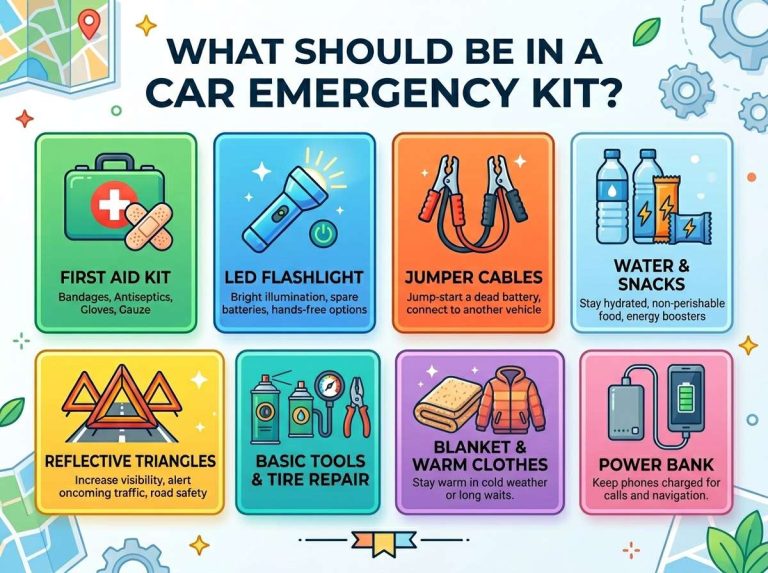
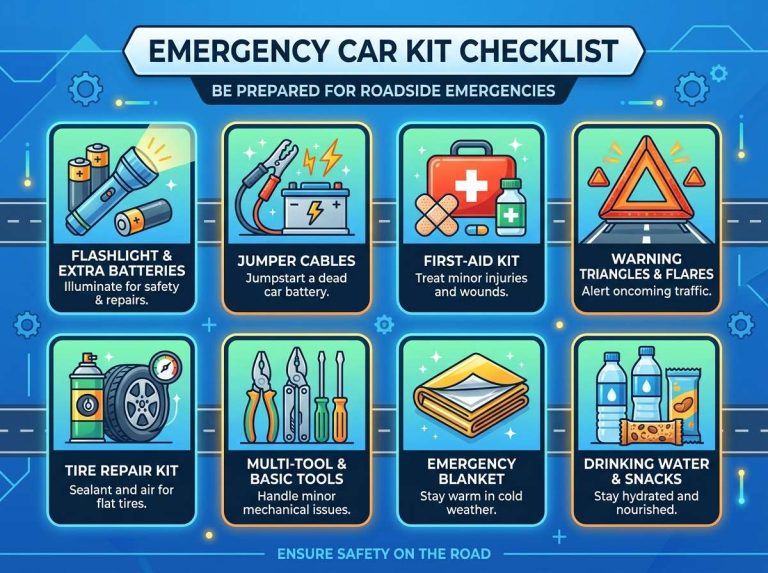
Being prepared means carrying the right gear. Keep these items in your trunk or car at all times.
A set of jumper cables. This is non-negotiable. Buy a good set and keep them accessible. Coiled cables that are easy to unravel are better than tangled ones.
Work gloves. Cheap cotton or latex gloves protect your hands from corrosion and sharp battery terminals.
A small flashlight or headlamp. If your battery dies at night, you’ll need light to see what you’re doing. Hands-free headlamps are best.
A cloth or rag. Use this to wipe down dirty terminals before you connect anything.
A battery jumper pack. Modern portable jumpers are small and don’t require another car. These are great for solo travelers or people who live alone.
A blanket (in winter climates). Wrapping a blanket around your battery keeps it warm and functional in cold weather. This is optional but helpful.
Quick Reference Guide
Here’s a fast reminder of the connection order:
- Connect red cable to your car’s positive terminal.
- Connect red cable to the other car’s positive terminal.
- Connect black cable to the other car’s negative terminal.
- Connect black cable to unpainted metal on your car’s engine (not the negative terminal).
- Start the donor car and wait three to five minutes.
- Start your car.
- Let your engine run for at least one minute.
- Disconnect black cable from your car.
- Disconnect black cable from the other car.
- Disconnect red cable from the other car.
- Disconnect red cable from your car.
Reverse the order of connection when you disconnect. This matters.
FAQ About Jump-Starting Cars
Q: Can I jump-start a truck with a small car? A: Yes, the voltage is the same (12 volts in most vehicles). The size of the vehicle doesn’t matter, only that the battery has enough charge.
Q: How long can I drive after a jump? A: Your engine needs to run for at least 20 to 30 minutes after a jump so your alternator can fully recharge the battery. A quick trip to the store might not be enough. Take a longer drive to be safe.
Q: Can I jump-start with a dead battery that won’t hold a charge? A: No. If a battery keeps dying even after you jump it, the battery is bad. You need a replacement.
Q: Is it safe to jump-start in the rain? A: It’s not ideal, but if you must, keep everything dry. Water conducts electricity. Don’t touch wet cables or let water splash on the battery terminals.
Q: What if the cable clamps are corroded? A: Scrub them clean with a wire brush before you use them. Corrosion blocks electrical flow and makes for a weak connection.
Q: Can a car with a dead battery damage the donor car? A: Not if you follow the proper connection order. The working battery shares power; it doesn’t get damaged in the process.
Q: How often should I replace my jumper cables? A: If they’re still in good shape, they last for years. Replace them if they crack, fray, or stop making solid connections.
Final Thoughts
Knowing how to jump-start your car is a life skill that saves time and money. You avoid expensive tow truck fees, and you can help friends or strangers in the same situation. But the key word here is safety.
Take your time with each step. Double-check the cable connections. Always put that final black cable on unpainted metal, never on the negative terminal. Wait long enough for the charge to transfer. Disconnect in the right order. These habits keep you, your car, and the other vehicle safe.
The first time you jump-start a car might feel scary or complicated. By your third or fourth jump, it becomes second nature. You’ll be the person people call for help, and you’ll know exactly what to do.
Keep a set of jumper cables in your car at all times. Store them in an easy spot in your trunk or back seat. When that day comes when your battery dies, you’ll be ready. You’ll know the right way to fix it, and you’ll do it safely. That’s what being a prepared driver is all about.

Peterson is an automotive safety enthusiast and product reviewer with a passion for helping drivers stay safe on the road. He researches and tests dash cams, backup cameras, TPMS systems, emergency tools, GPS trackers, and other vehicle safety products to provide honest, practical recommendations. Through CarSafeties.com, Peterson shares in-depth reviews, buying guides, and maintenance tips to help drivers make smarter and safer decisions.